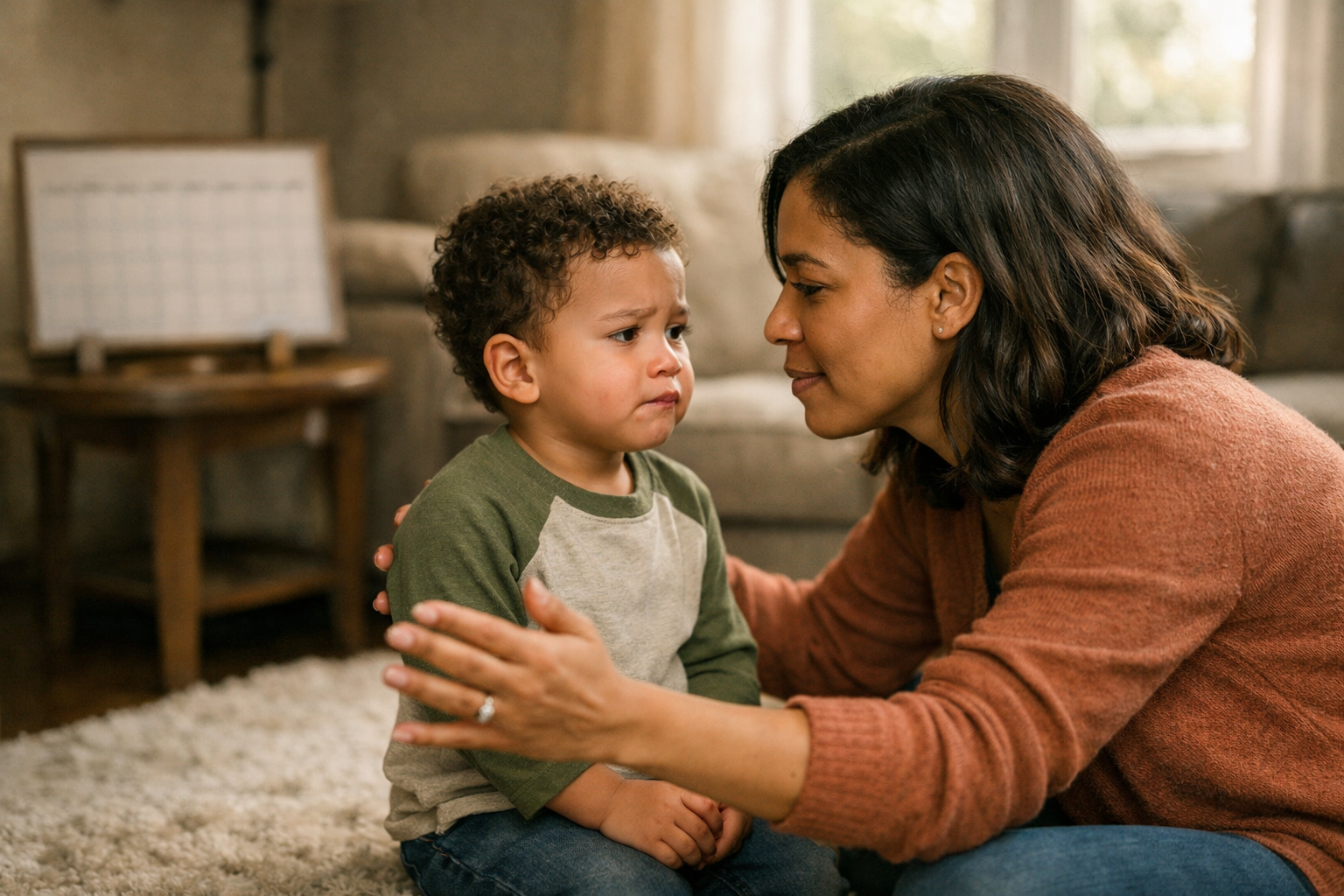
When Your Toddler Says “I Hate You” After Divorce
Hearing “I hate you” from a toddler or preschooler can sting—especially when your family has just changed. At this age, big feelings often come out as big words, because kids don’t yet have the language for worry, grief, or loyalty conflicts.
Most of the time, those words aren’t a true verdict on you. They’re a stress signal: “This feels scary,” “I miss the other parent,” “I don’t know what happens next,” or “I want control.” Your goal isn’t the perfect response—it’s steady, repeatable reassurance.
If you want a bigger-picture look at how divorce can affect kids over time (and what helps), read this guide: How does parental divorce affect children later in life: positive and negative effects.
Advice:
If you’re unsure what’s driving the blowups—drop-off days, new routines, bedtime battles, or separation anxiety—take the Parenting Test. It helps you reflect on your child’s triggers and your current coping tools. Use the results to pick one or two small changes you can repeat daily.
10 Quick Ways to Reconnect With Your Toddler Son After Divorce
These steps are designed for toddlers and preschoolers: short, simple, and doable when you’re tired. Use what fits your child and your co-parenting situation.
1) Use the 10-second reset (before you respond)
When your child yells, hits, or says something hurtful, pause just long enough to steady your voice. A calm tone is often the difference between a short storm and a full meltdown.
Try: “I’m taking a breath. I’m here.” Then move to the next step.
2) Name the feeling, then state the limit
Toddlers calm faster when they feel understood, but they still need clear boundaries. Keep it to one feeling word and one limit.
In-the-moment script: “You’re mad. I won’t let you hit.”
Then: “Hands go on your tummy / this pillow / your sides.”
3) Reassure with one repeatable sentence (don’t over-explain)
After divorce, toddlers often ask the same questions or repeat the same protest (“I want Daddy!”). Long explanations can add fuel. Use one consistent line so your child learns what to expect.
Script options:
“You have a mom and a dad. We both love you.”
“It’s okay to miss Dad. You’re safe with me.”
“Grown-ups live in different homes. You’re still loved in both.”
4) Build a predictable “hello” routine and a predictable “goodbye” routine
Transitions are a common trigger. A short routine reduces anxiety because your child knows what happens next.
Hello routine (2 minutes): shoes off, snack, choose one toy, then a 30-second cuddle.
Goodbye routine: one hug, one phrase (“See you after nap/daycare”), one wave—then go.
5) Offer tiny choices to reduce power struggles
Divorce can make toddlers feel powerless, which can show up as defiance. Choices restore a sense of control without giving up your boundary.
Try: “Do you want the blue cup or the red cup?” “Walk like a dinosaur or hold my hand?”
6) Use “connection before correction” after a rough moment
If your toddler has just screamed, thrown something, or clung to you, lead with closeness first. Once the nervous system settles, toddlers can hear guidance.
Script: “That was hard. Come here.” (brief hug)
Then: “Next time, say ‘Help!’ and I’ll come.”
7) Expect spikes around common divorce triggers
Many toddlers act out at specific times rather than “all the time.” Watch for patterns so you can plan support.
- Drop-offs/pick-ups: add a transition object (small toy, photo, matching bracelets)
- Bedtime: add a short “worry routine” (one question, one reassurance, one song)
- After visits: keep the first hour low-demand (snack, play, bath)
- New partner/new baby/new home: more clinginess and testing is common
8) Keep your child out of adult conflict (and out of adult questions)
Toddlers can feel torn even when they don’t understand the details. Avoid using them as a messenger or asking for reports about the other parent.
Try child-centered questions: “Did you play outside?” “What was your favorite part?” “Do you want to show me?”
9) Repair fast after you lose your patience
Repair builds trust. A quick, sincere reset teaches your child that relationships can be safe even after conflict.
Script: “I used a loud voice. That wasn’t okay. I’m sorry. I love you, and I’m working on calm.”
10) Make a small daily “us” moment (5 minutes counts)
You don’t need hours to reconnect. A predictable 5-minute ritual can be powerful for toddlers: floor play, a book, a song, or a silly handshake.
Tip: put it at a reliable time (after dinner, after bath, before bed) so your child can count on it.
What to say when your toddler blames you for the divorce
Some toddlers decide one parent “caused” the change, especially if they associate that parent with limits, rules, or the home that feels “less fun.” Keep your response simple and non-defensive.
Scripts to use:
“You’re mad at me. It’s okay to be mad. I’m still your mom, and I love you.”
“Grown-up decisions are not your job. Your job is to be a kid.”
“You didn’t cause this. I will take care of you.”
If your child’s behavior is escalating beyond typical toddler testing, you may also find this helpful: The impact of divorce on children's behavior problems and relationships.
When to seek professional help
Many big reactions are normal during family change, but extra support can be a smart next step. Consider talking with your child’s pediatrician or a licensed child therapist if you notice patterns that are intense, persistent, or worsening—such as frequent aggression that feels unsafe, extreme separation distress that doesn’t ease over time, sleep problems that severely disrupt functioning, or your child repeatedly talking about self-harm (even in a preschool way).
You can also seek help if you’re feeling overwhelmed, constantly on edge, or worried about how you’re coping. The American Academy of Pediatrics (AAP) offers guidance for families going through divorce and can be a helpful starting point for what’s typical and when to reach out.
If you need strategies for older kids who express anger more directly, these resources may help later on: 10 steps to deal with your teenage daughter who hates you because of the divorce and 10 steps to deal with teenage son who hates you because divorce.
Tip:
If you want a calmer plan for the next two weeks—what to say during “I hate you,” how to handle transitions, and which routine to build first—take the Parenting Test. It can help you choose a few realistic changes based on your child’s age and your current stress level. Then try one script and one routine daily and track what improves.
Your toddler doesn’t need perfect words. He needs a steady adult who stays close, keeps limits kindly, and repeats the same reassurances until his nervous system trusts the new normal.