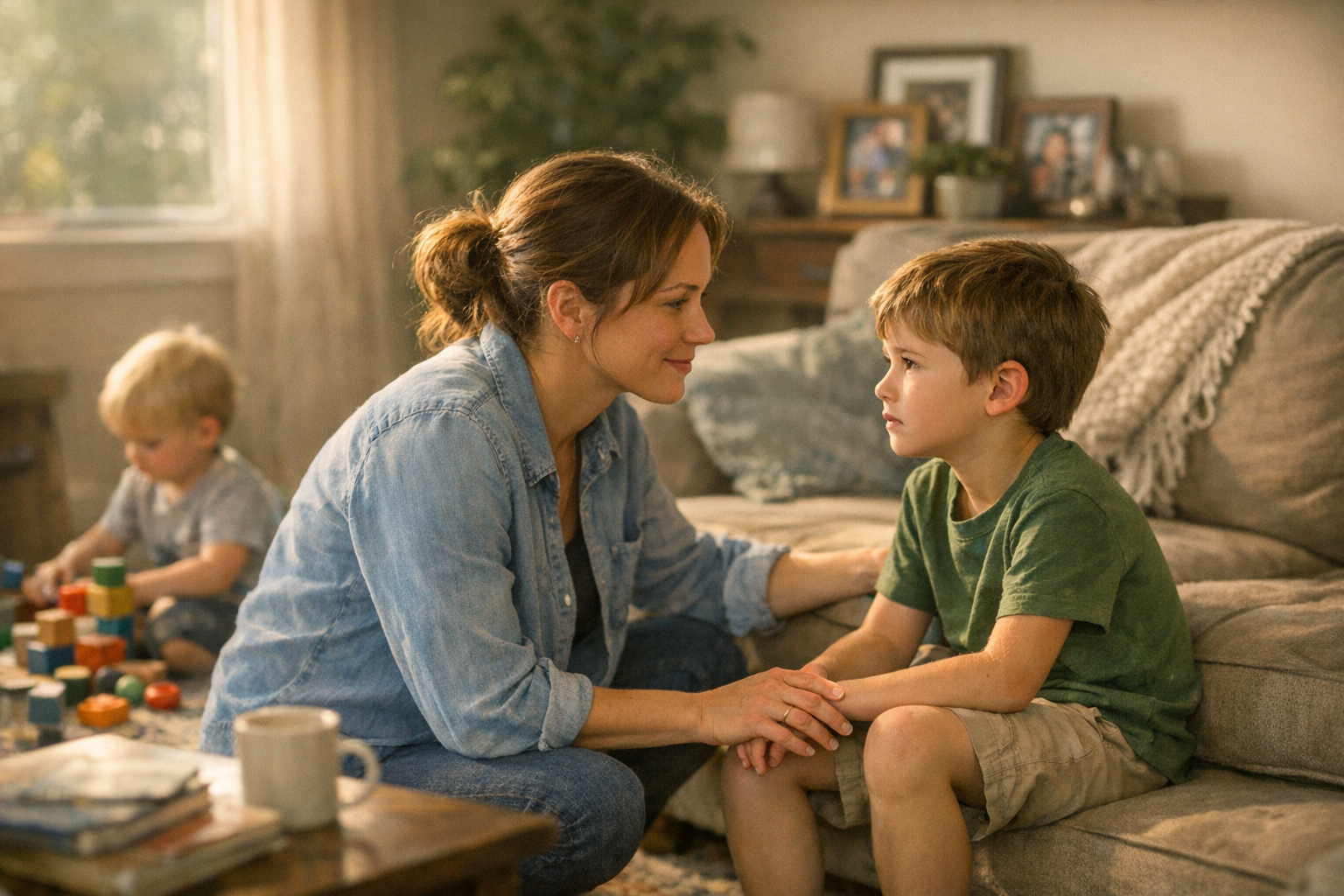
Kids don’t “just know” how to manage impulses, handle disappointment, or act respectfully when they’re tired, hungry, or frustrated. Discipline is how we teach those skills—through clear limits, steady follow-through, and repair after mistakes.
In this guide, you’ll get age-by-age strategies (toddlers through teens), practical consequence ideas, and simple scripts you can use in the moment—without turning every conflict into a power struggle.
If you want the full overview of what tends to work across ages, also see our main guide: Effective Discipline for Toddlers, Kids, and Teens.
Advice:
If you keep getting stuck in the same behavior loop (tantrums, arguing, ignoring directions), it can help to step back and look at what your child may be missing: sleep, skills, structure, or connection. The Parenting Test can help you reflect on your current approach and choose a few realistic next steps to try this week. Use it as a planning tool, not a label.
Start here / In this guide
Use these deeper reads when you want specific examples, definitions, or consequence ideas for a particular situation:
- How to discipline a child. Difference between child abuse, discipline and punishment
- How to punish a child. Positive and healthy ways to discipline your child
- 5 ways to discipline your child. Discipline methods and techniques
- At what age do babies understand discipline. Other ways to discipline your child
- How to teach a child respect and discipline
- Appropriate punishment for preschoolers, meddle school children and teens
- Top 10 effective punishments for kids
- Top 6 punishments for kids that work
- Corporal punishment of children. Consequences
- How to punish my teenager? Top 10 best creative punishments for teenager
- Top 5 creative punishments for a teenager
- Positive Discipline for Preschoolers: Effective, Age-Appropriate Consequences
- Discipline without yelling. How to make your toddler listen?
- Children’s bad behaviour at home. Consequences of disrespect and lack of discipline
What “effective discipline” means (and what it’s not)
Effective discipline is guidance that helps your child learn skills over time: self-control, problem-solving, empathy, and responsibility. It’s not about winning, scaring, shaming, or demanding “perfect behavior.”
Discipline vs. punishment vs. harm
Discipline teaches. Punishment focuses on a consequence after the fact. Some consequences can be healthy and appropriate, but others cross lines into humiliation or harm.
If you’re unsure where the line is, read How to discipline a child. Difference between child abuse, discipline and punishment. If you’re deciding what consequence to use, start with How to punish a child. Positive and healthy ways to discipline your child.
A simple formula that works at any age
When you’re in the moment, aim for this order:
- Regulate: pause, breathe, and lower your voice.
- Connect: name what you see (“You’re mad.”).
- Limit: set the boundary (“I won’t let you hit.”).
- Teach: show the next step (“Hands down. Stomp your feet or squeeze a pillow.”).
- Repair: help fix what happened (“Let’s check on your brother and help clean up.”).
Before you discipline: a quick behavior check
Many “discipline problems” are really a mismatch between expectations and your child’s current skills. Before you choose a consequence, check these common drivers:
- Body needs: hunger, thirst, tiredness, overstimulation
- Skills gap: doesn’t know how to ask, wait, share, transition, or calm down
- Environment: too many temptations, unclear rules, inconsistent routines
- Attention and connection: seeking closeness (even through negative attention)
- Big stress: changes at home/school, conflict, grief, bullying
Then ask: “What do I want my child to learn from this?” That answer should guide your response.
Age-by-age discipline: what works best
Ages 0–12 months: safety and co-regulation
Babies aren’t being “defiant.” Your job is to keep them safe and start building predictable routines.
- Use prevention: baby-proof, remove unsafe items, supervise closely.
- Use calm interruption: gently block grabbing/biting and redirect to a safe object.
- Build rhythms: regular sleep/feeds reduce meltdowns later in toddlerhood.
For a deeper look at when kids start understanding limits, read At what age do babies understand discipline. Other ways to discipline your child.
Ages 1–3: redirection, simple limits, and repetition
Toddlers learn through repetition and your calm follow-through. Keep rules short, concrete, and consistent.
Toddler scripts you can say without yelling
- Hitting/biting: “I won’t let you hit. Hitting hurts. Hands down.”
- Throwing: “Food stays on the table. If you throw, we’re all done.”
- Running off: “Stop. I need you close to me. Hold my hand or I’ll carry you.”
- Transition: “Two more minutes, then we go. Do you want to hop like a bunny or walk like a bear?”
Toddler checklist: what to do when they won’t listen
- Get close (touch shoulder, get to eye level).
- One sentence rule.
- One choice (two acceptable options).
- Follow through calmly within 5–10 seconds.
- Reconnect after (“You’re safe. Let’s try again.”).
If yelling has become the default, get practical step-by-step help in Discipline without yelling. How to make your toddler listen?
Ages 3–5: preschool consequences that teach
Preschoolers can start practicing responsibility, but they still need lots of structure and immediate feedback.
- Use “when/then”: “When toys are in the bin, then we can do a story.”
- Use related consequences: crayons used on walls means crayons are only used at the table with supervision.
- Practice the skill later: role-play gentle hands, taking turns, asking for help.
For specific examples by situation, see Positive Discipline for Preschoolers: Effective, Age-Appropriate Consequences and Appropriate punishment for preschoolers, meddle school children and teens.
Ages 6–10: routines, accountability, and problem-solving
School-age kids do well with clear expectations, predictable routines, and consequences that connect to the behavior.
School-age scripts for common problems
- Not starting chores/homework: “I can help you get started. We’ll do 5 minutes together, then you continue.”
- Arguing: “I’m happy to talk when voices are calm. Try again with a respectful tone.”
- Rudeness: “That sounded disrespectful. What’s a better way to say it?”
Consequence checklist (keep it fair and effective)
- Related: connects to the behavior (not random).
- Reasonable: short enough your child can succeed.
- Respectful: not shaming, not mocking, not public.
- Reliable: you can follow through every time.
For more methods you can mix and match, see 5 ways to discipline your child. Discipline methods and techniques. If you want examples of consequences that many families use, browse Top 6 punishments for kids that work and Top 10 effective punishments for kids.
Ages 11–13: boundaries plus dignity
Tweens want independence but still need strong structure. Focus on clarity, consistency, and respect.
- State the rule and the “why” once: “Phones charge in the kitchen at night so sleep is protected.”
- Use collaborative planning: ask, “What’s your plan to keep grades up and still have downtime?”
- Link privileges to responsibilities: “When missing work is turned in, then gaming comes back.”
Ages 14–18: agreements, privileges, and real-world skills
With teens, discipline works best when it looks like coaching: calm conversations, clear agreements, and consequences tied to safety and responsibility.
Teen conversation script (use as a template)
1) Start with your concern: “I’m worried about you getting home late and not answering.”
2) Set a clear limit: “You need to text if you’ll be late. If you don’t, you won’t be able to go out next weekend.”
3) Invite problem-solving: “What’s a realistic plan so this doesn’t happen again?”
4) Confirm the agreement: “So we’re agreed: text within 10 minutes, and if you miss that, you take a break from going out for a week.”
Teen consequence ideas (connected and non-humiliating)
- Curfew issues: earlier curfew for a set time; extra check-ins.
- Unsafe tech choices: temporary limits, device use in common spaces, review privacy settings together.
- Not following through: pause a privilege until the responsibility is completed.
If you need more scenario ideas, see How to punish my teenager? Top 10 best creative punishments for teenager and Top 5 creative punishments for a teenager.
Common discipline pitfalls (and what to do instead)
Pitfall: consequences that are too big, too long, or unrelated
Overly harsh or unrelated consequences often lead to lying, shutdown, or bigger power struggles. Instead, keep consequences short, connected, and focused on skill-building.
Pitfall: repeating the rule without follow-through
If you say it five times and act on the sixth, kids learn “the first five don’t count.” Instead, say it once, move closer, and follow through calmly.
Pitfall: using physical punishment
Many medical and child health organizations discourage corporal punishment because it can increase aggression and harm the parent-child relationship. If you’re weighing that option or grew up with it and want alternatives, read Corporal punishment of children. Consequences.
Build respect at home (without fear)
Respect grows fastest when kids experience respectful leadership: calm tone, clear rules, and predictable repair when someone messes up—parent included.
- Model it: speak the way you want them to speak.
- Name it: “That was respectful—thank you for trying again.”
- Practice it: rehearse how to disagree, how to ask, and how to apologize.
For specific strategies, see How to teach a child respect and discipline. If disrespect and conflict at home are escalating, you may also find clarity in Children’s bad behaviour at home. Consequences of disrespect and lack of discipline.
When to seek professional help
If you’re seeing frequent, intense behaviors that feel beyond typical parenting challenges—such as aggression that causes injury, threats of self-harm, running away, persistent school refusal, or behavior that escalates despite consistent routines and limits—consider talking with your child’s pediatrician or a licensed child mental health professional. You can also reach out to your school counselor for support and referrals.
For general behavior and development guidance, you can review resources from the American Academy of Pediatrics (AAP) and the Centers for Disease Control and Prevention (CDC).
Tip:
If you’re unsure whether to focus on firmer boundaries, better routines, more connection, or clearer consequences, a quick self-assessment can help you prioritize. Take the Parenting Test and choose one small change to practice for 7 days (for example: a shorter script, a more related consequence, or earlier prevention). Small, steady adjustments are often easier to maintain than a full reset.
Discipline works best when it’s predictable, respectful, and aimed at teaching—not controlling. Start with the smallest change you can stick with, repeat it consistently, and build from there as your child grows.