Teaching Kids Conflict Resolution at School: 10 Real-Life Examples (With Scripts and Checklists)
School conflicts are normal: kids are learning how to share space, manage big feelings, and speak up respectfully. The goal isn’t to eliminate disagreements—it’s to help your child handle them safely and confidently.
This guide focuses on school-specific conflict resolution: peer-to-peer issues, when (and how) to involve a teacher, and practical language your child can use in the moment. For broader family conflict strategies you can use at home, see this guide: How to solve family problems and conflicts. Best conflict resolution techniques.
Recommendation:
If you’re not sure whether to coach your child, call the teacher, or escalate to the school counselor, a quick self-check can help you choose a calmer next step. The Parenting Test can guide you toward a response that matches your child’s age, temperament, and the seriousness of the situation. Use it as a starting point, then follow up with the school if safety is involved.
Constructive vs. destructive conflict (in school terms)
- Constructive conflict ends with a workable solution (or a respectful “agree to disagree”), repaired relationships, and safer behavior next time.
- Destructive conflict includes name-calling, intimidation, repeated exclusion, threats, physical aggression, or ongoing power imbalance.
Before you jump in: a quick school-conflict checklist for parents
- Safety first: Was anyone threatened, hit, or cornered? Are there injuries or fear of returning to school?
- Pattern or one-off: Is this the first incident, or has it happened repeatedly?
- Power imbalance: Older student vs. younger, group vs. one child, “popular kid” vs. targeted child.
- Place and supervision: Classroom, hallway, bus, lunch, recess, sports, group chat.
- Goal: What does your child want—space, an apology, a rule clarified, a new seat, help joining a group?
How to talk so you get the real story
Start with calm, specific questions. Kids often describe the outcome (“He was mean!”) before the sequence of events. Try:
- “Walk me through what happened from the beginning.”
- “What did you do or say right before it blew up?”
- “Who saw it? Where were adults?”
- “What do you wish you’d said instead?”
If you want more at-home practice conversations, you can also use: Teaching Kids Conflict Resolution: 10 Real Family Scenarios.
10 School Conflict Scenarios: What to Do + What Your Child Can Say
1) Someone cuts in line
Goal: Set a boundary without starting a power struggle.
- Child can say: “I think I was next. You can go after me.”
- If they refuse: “I’m going to ask the teacher to help us follow the line rule.”
- Parent coaching tip: Practice a neutral voice and “broken record” repetition.
2) “That’s my seat” or “You’re in my spot”
Goal: Offer choices and avoid insults.
- Child can say: “I sit here usually. Want to switch, or should we ask the teacher where we should sit?”
- Teacher collaboration idea: Ask for assigned seats if this repeats.
3) A group won’t let your child join at recess
Goal: Build entry skills and identify when exclusion becomes bullying.
- Child can say: “Can I join for the next round?” or “What are the rules? I can do that.”
- Plan B: “Okay—who else wants to play something else with me?”
- Parent step: If this is constant exclusion by the same group, document dates and ask the teacher what supervision/support is available.
4) Teasing about clothes, lunch, body, or interests
Goal: Use short responses, exit, and report patterns.
- Child can say: “Stop. I don’t like that.” Then move away.
- If it continues: “I’m going to tell an adult because I asked you to stop.”
- Parent coaching tip: Keep it brief—long comebacks often escalate.
5) A friend shares a secret
Goal: Repair trust and set a clear boundary.
- Child can say: “I told you that privately. Please don’t share my stuff.”
- Next step: “I need a break from this friendship for now.”
- Teacher role: In elementary school, a teacher can facilitate a simple repair conversation.
6) Group project: one kid does nothing (or bosses everyone)
Goal: Use role clarity and teacher support early.
- Child can say: “Let’s split it into parts. I’ll do A. Who’s doing B and C?”
- If a student refuses: “We tried to assign roles. Can you help us set a plan?” (to teacher)
- Parent step: Encourage your child to ask for a rubric or role sheet instead of “complaining” about teammates.
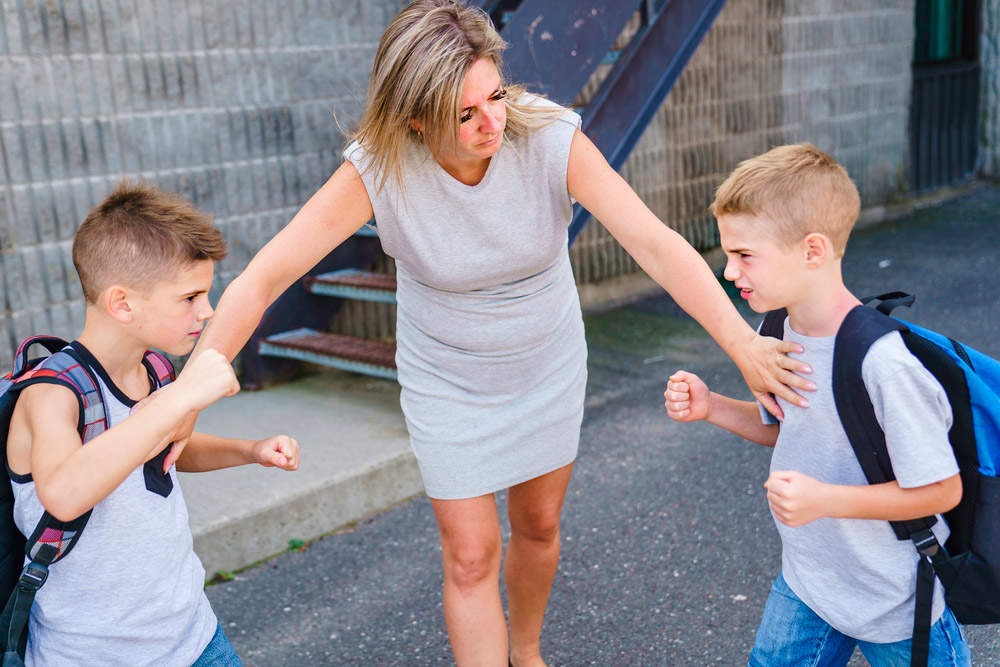
7) Rough play turns into a shove or hit
Goal: Safety, immediate adult involvement, and clear boundaries.
- Child can say: “Stop. Don’t touch me.” Then step back and get an adult.
- Parent step: Ask the school what happened, how it will be supervised going forward, and what the safety plan is.
- Do not coach: Retaliation. It can increase harm and complicate school discipline.
8) A misunderstanding spreads (“They said you…”)
Goal: Clarify directly, avoid piling on, and stop rumors.
- Child can say: “That’s not what I said. Here’s what I meant.”
- If it’s messy: “I’m not talking about this behind people’s backs. Let’s ask [name] together.”
- Parent coaching tip: Teach “verify before you react.”
9) Teacher conflict: your child feels treated unfairly
Goal: Advocate respectfully and gather facts.
- Child can say (to teacher): “Can you help me understand what I did wrong and what you want me to do next time?”
- Parent email/script: “I’d like to understand what happened and how we can support a better plan moving forward. When can we talk?”
- Collaboration tip: Ask for one clear behavior goal and one classroom support (seat change, check-in, visual reminders).
10) Cyber conflict connected to school (group chats, memes, gaming)
Goal: Save evidence, block/report, and involve the school if it affects learning or safety.
- Child can do: Don’t respond. Screenshot. Block/report.
- Child can say at school: “I’m not discussing this online. If there’s a problem, talk to me at school with an adult.”
- Parent step: Follow school policy for reporting, and consider tightening privacy settings and device rules.
Practice at home: a 4-step script kids can remember
- Name it: “I don’t like that.”
- Boundary: “Stop.” / “Don’t touch my stuff.”
- Option: “We can take turns.” / “Let’s ask the teacher.”
- Exit: “I’m walking away now.”
For more step-by-step skill-building, see: How to teach kids conflict resolution strategies. If you want school-ready practice ideas for tweens and teens, try: Conflict Resolution Activities for Middle School Students.
When to involve the school (and what to ask for)
- Involve the school right away for threats, physical aggression, harassment, repeated targeting, discriminatory language, or fear of attending school.
- Request a plan when incidents repeat: increased supervision, seating changes, a safe person to check in with, structured recess options, or mediated repair conversations.
- Ask for documentation of what the school observed and what steps are being taken.
When to seek professional help
Consider consulting your pediatrician, a licensed mental health professional, or the school counselor if your child shows persistent anxiety, sleep problems, frequent headaches/stomachaches, significant mood changes, or refusal to attend school. If your child talks about self-harm or you believe they may be in immediate danger, seek urgent help right away. For crisis resources in the U.S., you can call or text 988 (the Suicide & Crisis Lifeline).
Guidance on children’s mental health and bullying is available from the American Academy of Pediatrics (AAP) and the Centers for Disease Control and Prevention (CDC).
Tip:
If you keep replaying a school conflict and aren’t sure whether to step back or step in, it helps to map the situation: safety, frequency, and power imbalance. The Parenting Test can help you organize what you’re seeing and choose a respectful next move—coaching your child’s words, partnering with a teacher, or requesting a formal plan. Bring your notes into any school meeting so the conversation stays clear and solution-focused.
Most kids can learn conflict skills with practice, calm coaching, and the right level of adult support. When you teach simple scripts, help them reflect without blaming, and collaborate with teachers early, school conflicts become opportunities to build confidence and safer relationships.