Handling Toddler and Preschool Conflicts: Quick Scripts, Routines, and When to Step In
Toddler and preschool conflicts can look intense—grabbing, yelling, “Mine!”, tears—but most of the time, they’re part of learning: sharing space, waiting, handling frustration, and using words instead of hands.
This guide focuses on in-the-moment steps you can use right away, plus simple routines that prevent the same fights from repeating at home or in preschool.
If you want a broader family approach for all ages, see this main guide: How to solve family problems and conflicts. Best conflict resolution techniques.
Advice:
If preschool conflict is happening often and you’re unsure how much to step in, a quick check-in can help you respond consistently. The Parenting Test can help you think through what’s driving the behavior (tiredness, skills, environment) and choose a calm next step. Use it before you talk with your child or message the teacher so your plan is clear.
The 10-Second Rule: When to Step In Immediately
For toddlers and preschoolers, “work it out” usually needs adult structure. Step in right away if you see:
- Hands or bodies involved: hitting, pushing, grabbing, biting, throwing toys, blocking a doorway.
- One child is stuck: frozen, crying hard, cornered, or clearly unable to speak up.
- Escalation signs: clenched fists, raised voices, fast breathing, repeated “No!” without stopping.
- Unsafe objects or space: hard toys, climbing areas, tight spaces where kids can fall.
If it’s a mild disagreement (two kids pouting, both safe, no grabbing), you can pause for a moment and coach from nearby.
Common Triggers at Ages 2–5 (So You Can Prevent the Next One)
Many preschool conflicts repeat because the trigger repeats. The most common triggers include:
- Scarcity: one popular toy, one tricycle, one marker color, one spot on the rug.
- Transitions: cleanup, lining up, leaving the playground, bedtime, getting into the car seat.
- Body boundaries: hugging, crowding, “in my space,” knocking down blocks.
- Skill gaps: they don’t yet know the words for “I’m still using that” or “Can I have a turn?”
- Basic needs: hunger, thirst, overstimulation, tiredness, needing a bathroom break.
Prevention often looks simple: two of the popular thing, a visible turn-taking routine, a 2-minute transition warning, or a snack/water break before playdates.
In-the-Moment: A Simple 4-Step Coaching Script
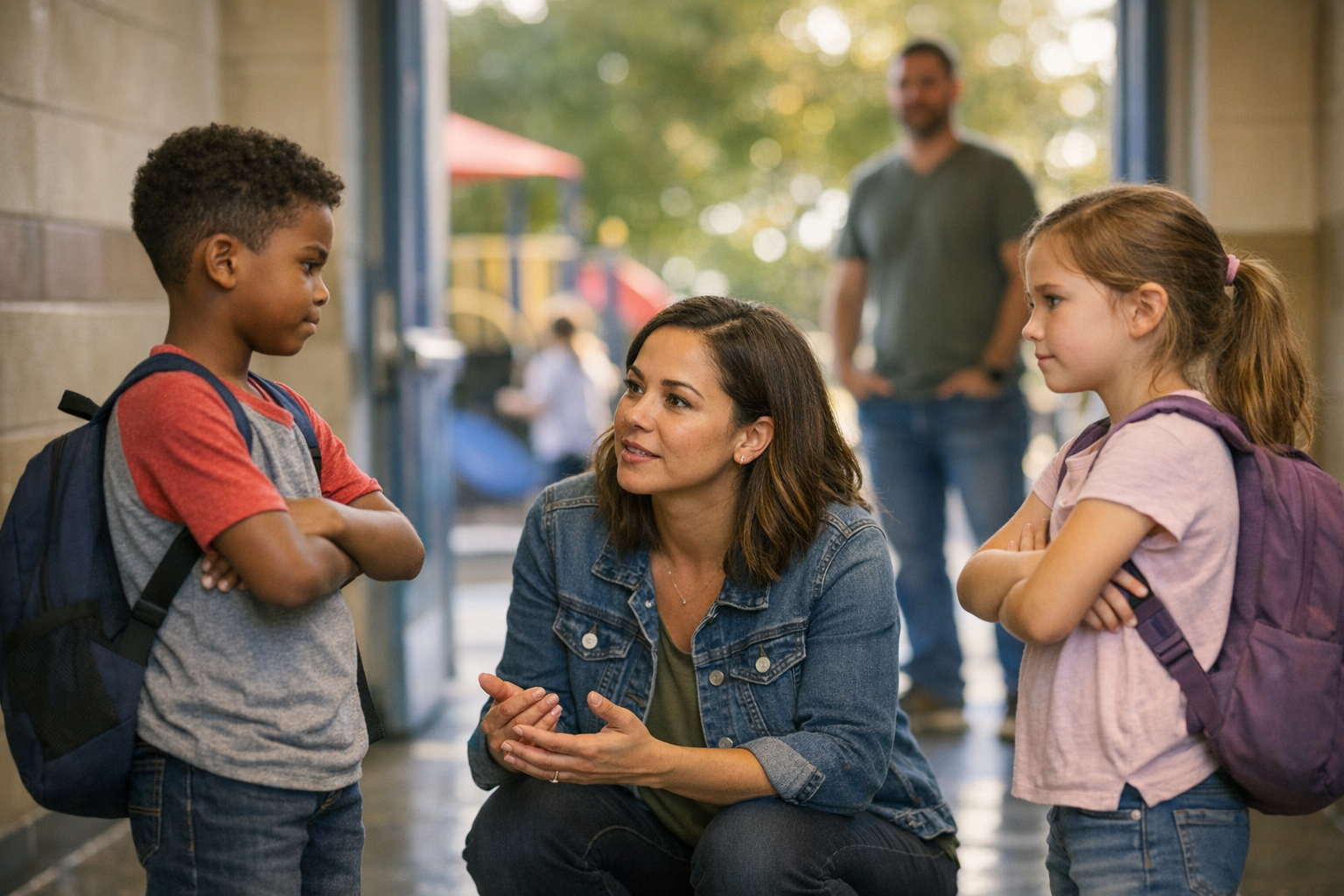
When conflict starts, your job is to stop the unsafe behavior and lend your words until your child can use their own.
Step 1: Block and label the rule (short and calm)
Say: “I won’t let you hit. Hands stay down.”
Say: “I see grabbing. Toys are not for pulling.”
Step 2: Name the feeling (without debating the story)
Say: “You’re mad. You wanted the truck.”
Say: “You’re upset. You weren’t done.”
Step 3: Give each child one sentence to be heard
Keep it very short—toddlers can’t hold long explanations in their heads during big feelings.
- To Child A: “Tell me: ‘My turn.’”
- To Child B: “Tell me: ‘I’m still using it.’”
Step 4: Offer two acceptable solutions
At 2–5, choices work better than negotiations.
- Turn-taking: “One minute for you, then you hand it to Sam.”
- Trade: “You may trade: blocks for truck.”
- Find another: “This truck is taken. Let’s pick a different one.”
- Play side-by-side: “You build here; you build there.”
If they can’t choose, you choose calmly: “I’m choosing. Sam has it first. You can have it when the timer beeps.”
Quick Scripts for the Most Common Preschool Conflicts
1) “Mine!” and grabbing
Adult: “Stop. I won’t let you grab.”
“Say: ‘Can I have a turn when you’re done?’”
“We can do a timer, or you can pick another toy. Which one?”
2) Blocking, pushing, getting too close
Adult: “Back up. I won’t let you push.”
“Say: ‘Move please’ or ‘I need space.’”
“Let’s make room so everyone is safe.”
3) Knocking down towers or ruining play
Adult: “Stop. You can’t knock it down.”
“You can ask: ‘Can I join?’ or build your own tower.”
“If you’re feeling silly, we can stomp outside—towers stay safe.”
4) Biting (common in toddlers, still needs firm limits)
Adult: “No biting. I won’t let you bite.”
“Biting hurts. Teeth are for food.”
Then focus on safety and calming: separate, comfort the child who was bitten, and help the biter settle. Later, practice a replacement: “Say ‘Help!’” or “Say ‘My turn!’”
Set Up Routines That Reduce Fighting (Home and Playdates)
- Turn routine: use a simple timer and the same phrase every time: “When it beeps, it’s the next turn.”
- Duplicate the hot items: two shovels, two dolls, two favorite cars when possible.
- Transition warnings: “Two more slides, then we go.” Follow through.
- Teach a “pause spot”: a calm place to reset (not framed as punishment). “We’re going to the pause spot to breathe.”
- Practice scripts when calm: role-play “Can I have a turn?” and “Stop, I don’t like that.” during pretend play.
How to Partner With a Preschool Teacher (Without Blame)
If conflict is happening at school, your goal is a shared plan, not a courtroom. Ask for specifics and align on consistent language.
- Ask: “What happens right before the conflict?” “What helps calm my child fastest?”
- Share: “At home we’re practicing: ‘My turn when you’re done.’ Can you use that phrase too?”
- Agree on one routine: timer turns, assigned roles, or a predictable transition job.
If you’re also seeing aggression triggers outside school, this guide may help you spot patterns: How to avoid conflicts at school. What triggers aggression?
What to Do After the Conflict (Keep It Under 2 Minutes)
Long lectures don’t stick at this age. Aim for: name it, repair it, practice it.
- Name: “That was a hard moment. You were mad.”
- Repair: “Let’s check on Casey.” “Let’s help rebuild.” “Let’s bring an ice pack.”
- Practice: “Next time say, ‘Help!’” (Have them repeat it once when calm.)
If your child needs to apologize, keep it simple and real. Instead of forcing “sorry,” try: “Show gentle hands,” “Can you help fix it?” or “Can you bring them a tissue?”
When to Seek Professional Help
It’s common for young children to have occasional hitting, biting, or big tantrums—especially during transitions and when tired. Consider getting extra support if you notice any of the following:
- Frequent, intense aggression that doesn’t improve with consistent coaching and routines over several weeks.
- Injuries to other children, or your child seems unable to stop once escalated.
- Behavior changes that are sudden or tied to major stressors (sleep loss, family changes, recent trauma).
- School is concerned or your child is being repeatedly removed from activities due to safety.
Start with your child’s pediatrician for guidance. You can also ask the preschool about behavioral supports and screening resources. For developmental and behavior guidance, parents can reference the American Academy of Pediatrics.
Keep the Focus: Skills, Not “Good” or “Bad” Kids
At ages 2–5, conflict is usually a sign your child needs practice with waiting, asking, coping, or boundaries—not a sign they’re “mean.” If you stay consistent with short scripts and predictable routines, many conflicts shrink quickly.
For a kid-friendly step sequence you can repeat at home, you may also like: 5 Key Steps to Help Kids Resolve Conflicts Peacefully. If you also parent older kids, these classroom ideas can be useful later on: Conflict Resolution Activities for Middle School Students.
Tip:
If you’re seeing the same conflict loop (grabbing, hitting, or daily complaints from school), it may help to pinpoint one priority skill to practice this week. The Parenting Test can guide you toward a small, realistic plan—what to say in the moment, which routine to add, and when to involve the teacher or pediatrician. Consistency matters more than finding the perfect phrase.
With toddlers and preschoolers, your calm structure is the bridge to better behavior: stop unsafe actions, name feelings, coach a short script, and practice the same solution again tomorrow.