Preschool Conflict Resolution: Why Little Kid Fights Matter
Preschool squabbles can pop up fast—over toys, turns, personal space, or “who had it first.” In the moment, it can feel like you’re breaking up the same argument all day.
But these mini-conflicts are where toddlers and preschoolers practice big skills: calming their bodies, using words, and learning that relationships can be repaired.
This guide focuses on what to do in the moment: quick steps, ready-to-use scripts, and simple games that build problem-solving without turning every fight into a long lecture.
Advice:
If conflict moments feel unpredictable, a simple check-in can help you notice patterns—like whether your child gets stuck on waiting, sharing, or big feelings. The Parenting Test can help you reflect on your responses and choose a few consistent phrases and routines to practice at home. Small, repeatable steps often work better than one “perfect” talk.
For a broader, all-ages breakdown of conflict resolution basics (including problem-solving steps for the whole family), see this main guide: How to solve family problems and conflicts. Best conflict resolution techniques.
What Makes Toddlers and Preschoolers Fight (Common Triggers)
Knowing the trigger helps you pick the right fix. With ages 2–5, conflicts usually come from skill gaps, not “bad attitude.” Common triggers include:
- Scarcity: one toy, one seat, one adult, one turn
- Waiting: transitions, cleanup, lining up, being interrupted
- Big feelings: hungry, tired, overstimulated, sick, or off-routine
- Body boundaries: grabbing, crowding, rough play, “I don’t like that!”
- Language limits: they can’t find the words fast enough
- Power struggles: “I decide,” “Mine,” “No!”
If you’re also dealing with peer conflicts at daycare or preschool, this related guide can help you coordinate with teachers: How to Handle Kid Conflicts at Preschool and School.
The 60-Second Intervention: A Quick Step-by-Step
Use this simple sequence when voices rise or hands get grabby. The goal is safety first, then skills.
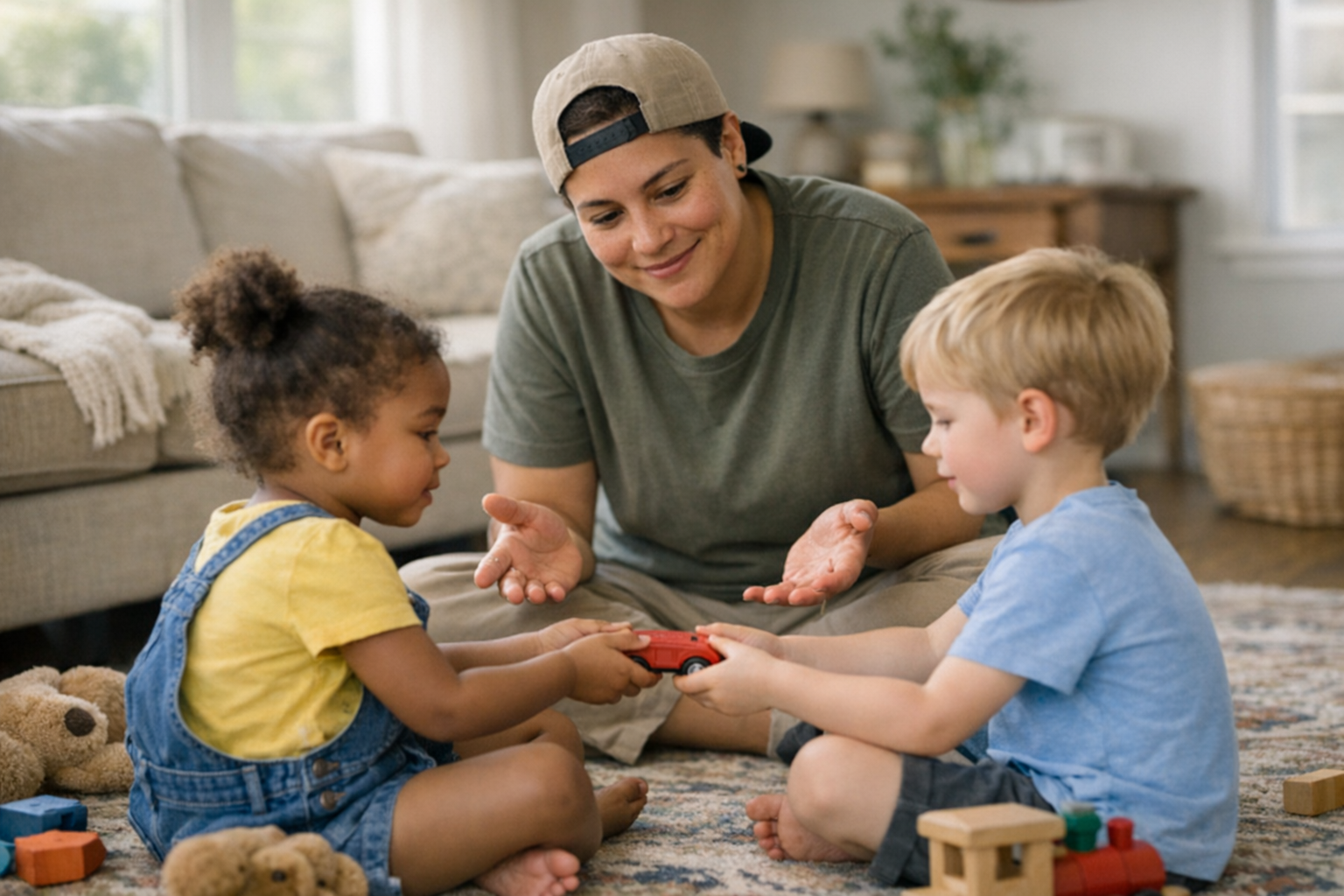
- Stop and block (calmly): Step close. Put a hand between bodies or gently hold the toy. Script: “I won’t let you hit/grab.”
- Name the problem in one sentence: “You both want the truck.”
- Set one clear boundary: “Toys are for playing, not pulling.”
- Offer two choices that work for you: “You can take turns with the timer, or you can find another truck.”
- Coach the words (short and concrete): “Say: ‘Can I have a turn when you’re done?’”
- Close with repair: Even a tiny repair counts. “Hands to yourself. Are you okay? Do you want a high-five to restart?”
If they’re too escalated to choose or talk, skip problem-solving and go straight to calming (see “Get a Grip” below). You can revisit the lesson later during play.
In-the-Moment Scripts (Use the Ones You Can Repeat)
Short scripts work best because young kids can copy them. Pick 3–5 phrases and use them consistently.
- When a toy is grabbed: “Stop. I’m using it. You can ask for a turn.”
- When a child won’t share: “You don’t have to give it. You do have to use kind words.”
- When both claim it: “We can’t solve it by yelling. We’re going to do turns.”
- When someone is hurt: “Check: Are you okay? Ask: Do you need help?”
- When teasing starts: “That’s not kind. Try again with a friendly voice.”
- When kids run to you to “judge”: “Tell your friend what you want. I’ll help if you get stuck.”
For more peer-focused ideas (sharing, joining in, handling “no”), you can also read: 10 Toddler-Friendly Ways to Handle Conflicts With Friends.
Routines That Prevent Repeat Fights
Most preschool conflicts repeat because the day repeats. A few small routines can reduce how often you have to step in.
- “Two of the same” rule: For high-demand toys, buy/borrow two when possible (balls, trucks, markers).
- Turn-taking tool: Use a sand timer or phone timer. Script: “When the timer is done, it’s the next turn.”
- Transition warning: “Two more minutes, then cleanup.” (Then follow through.)
- Calm-down spot: A cozy corner with a soft item and a book. Not a punishment—just a reset.
- Repair ritual: After conflict: “Check, help, restart.” (Are you okay? Can I help? Want to play again?)
How Play Helps Kids Learn Conflict Skills
Young children learn best through play—especially when the stakes are low and an adult is calmly coaching. Use these simple games to practice:
- Waiting and turn-taking
- Asking with respectful words
- Calming down before problem-solving
- Finding more than one “fair” solution
- Repairing after someone is upset
Game 1: “The Sweet Problem”
Goal: Practice negotiating, making joint decisions, and resisting the urge to “win” immediately.
You’ll need: One small snack per pair (cookie or cracker) and one napkin.
How to play:
- Pair kids up. Place the snack on a napkin between them.
- Say: “This snack is for one of you—but you can only have it if your partner freely gives it to you. You may talk, but no grabbing.”
- Watch what happens. If they get stuck, coach one sentence: “Can we split it?” or “You can have it first, I’ll have the next one.”
- Then offer a second snack and say: “Try again using your best teamwork.”
Questions to discuss:
- What words helped?
- What felt unfair?
- What’s a solution that works for both people?
Game 2: “Ask for the Toy”
Goal: Practice asking and responding without whining, grabbing, or bossing.
How to play:
- Put kids in pairs. One child holds a favorite toy.
- Coach Child B to ask with a script: “Can I have a turn when you’re done?”
- Coach Child A to answer with choices: “Yes, after I finish,” or “Not yet—pick another toy.”
- Switch roles after a short round.
Make it more realistic: Add a timer for the “after I finish” option so the waiting child has a predictable endpoint.
Game 3: “Get a Grip” (A Quick Calm-Down Move)
Goal: Lower intensity so kids can listen and choose.
How to teach it: When your child is calm, practice this “strong, calm body” move.
- Have your child wrap their hands around their elbows.
- Gently press arms to chest.
- Take 3 slow breaths together. Script: “Squeeze… breathe… relax.”
In real conflicts, keep it short: “Get a grip. Three breaths. Then we’ll solve it.”
Game 4: “Kind Choices” Circle (Connection Without Forced Hugs)
Goal: Build positive connection and teach consent and boundaries.
How to play: Sit in a circle and practice friendly greetings that everyone can choose from.
- Wave
- High-five
- Fist bump
- “Hello” with a smile
- Hug only if both kids want it
Script: “In our family/class, we ask first. Everyone gets to choose what feels comfortable.”
Role-Play a Real Problem (With Permission)
Goal: Rehearse what to do next time—without blaming.
How to do it:
- Pick one recent, common conflict (toy grabbing, pushing in line, yelling “Mine!”).
- Keep it brief and neutral: “Yesterday there was a fight about the blocks.”
- Ask your child to help you act out a better ending with toys or stuffed animals.
Try this simple “better ending” script:
- “Stop. I’m using it.”
- “Okay. Can I have a turn when you’re done?”
- “Yes. When the timer is done.”
- “Deal.”
When to Seek Professional Help
It’s common for young kids to hit, bite, or melt down sometimes—especially when they’re tired or frustrated. Consider talking with your pediatrician, a child psychologist, or your child’s school support team if you notice:
- Frequent aggression that doesn’t improve with consistent coaching and close supervision
- Injuries, serious threats, or behaviors that make childcare/school unsafe
- Big regressions in sleep, toileting, or behavior alongside intense outbursts
- Concerns about development, language delays, sensory challenges, or anxiety that may be fueling conflicts
For general child development and behavior guidance, many families start with resources from the American Academy of Pediatrics.
Keep Expectations Age-Realistic (And Track Small Wins)
For toddlers and preschoolers, the win is rarely “they solved it perfectly.” The win might be: they used a calmer voice, they accepted a timer, they tried one repair word, or they kept hands to themselves with your help.
If you want extra practice ideas for older kids in your family (or a classroom you support), this resource may be useful: Conflict Resolution Activities for Middle School Students.
Tip:
If you’re not sure whether to coach sharing, boundaries, or calming first, choose one “starter skill” and repeat it for two weeks. The Parenting Test can help you pick a realistic focus and build a simple plan you can use during everyday play and transitions. Consistency matters more than saying the perfect thing.
With patient repetition—short scripts, predictable routines, and a quick repair ritual—kids learn that disagreements are something they can work through, not something that has to end in tears or grabbing.